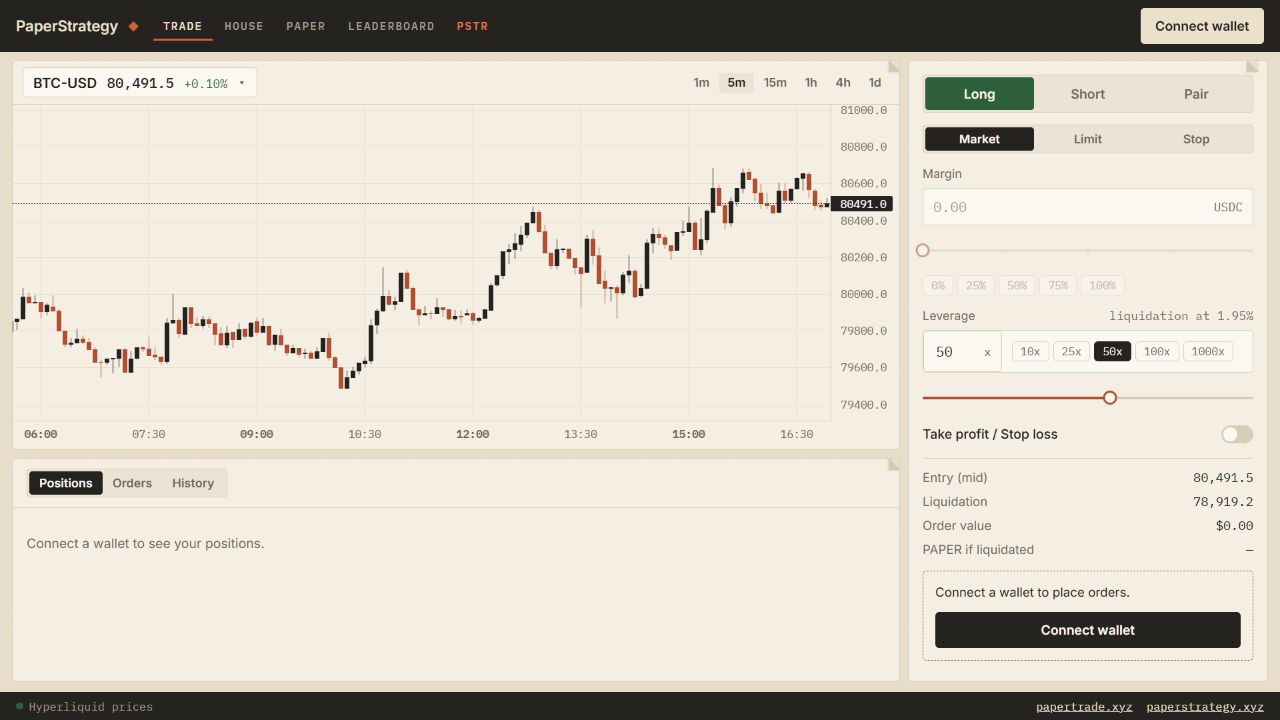
PaperStrategy announced its terminal on 26 October 2026. The pre-existing PSTR token and treasury strategy have a separate history. The terminal offers individual positions, paired longs/shorts and engines that repeat pairs. Public Pair and Engine screens were reviewed without a wallet on 27 October.
Documentation caps pairs and engines at 100x because closes wait in Papertrade’s queue. It lists up to 20 simultaneous pairs per engine, while the reviewed interface offers choices up to 10. TP/SL, fast closes and recovery from a single-leg failure are operator claims, not tested guarantees.
The service says its 30-day session key is stored encrypted on its server. Turning trading off deletes that copy and cancels armed protections, while open positions remain; onchain revocation is separate. A stolen trading key can cause losses even if withdrawals are disallowed.
The stated 2% win fee and 0.5% builder fee apply after protocol payout adjustments; they are not the whole reduction from raw profit. Deposit transfer costs and revocation gas are separate. The PSTR token’s stated 10% trade tax is a distinct mechanism. Actual fees, server security, engine behaviour and withdrawal flows were not tested.
On 29 October 2026, the project announced ETH/BTC exposure. The 1 November review observed an ETH/BTC selection and dedicated order ticket, distinct from the existing same-market Pair/Engine farming modes. It composes two Papertrade positions rather than a native ETH/BTC instrument. Each leg can be liquidated on its own coin move even if the ratio changes little; separate fills, queue delays and a remaining exposed leg are untested risks. The existing 100x Pair/Engine limit is not automatically a limit for this separate ticket.
On 30 October, the project announced copy trading with a budget and amount per trade, copying new openings and following closes, with claimed exclusion of delta-neutral farmers. Public 24h/3d/7d/30d rankings, a feed and copy controls loaded on 1 November; connection was required to start. Budgets, farmer filters, latency, fees, key controls, stop behaviour and divergent closes were not tested. Rankings were not independently recalculated and do not promise reproduced PnL.
 papergames